Lithium-ion battery
|
An example of a Li-ion battery (used in the Nokia 3310 mobile phone) | |
| Specific energy | (0.36–0.875 MJ/kg) |
|---|---|
| Energy density | (0.90–2.43 MJ/L) |
| Specific power | ~250-~340 W/kg[1] |
| Charge/discharge efficiency | 80–90%[4] |
| Energy/consumer-price | 2.5 W·h/US$[5] |
| Self-discharge rate |
8% at 21 °C 15% at 40 °C 31% at 60 °C (per month)[6] |
| Cycle durability |
400–1200 cycles [7] |
| Nominal cell voltage | NMC 3.6 / 3.85 V, LiFePO4 3.2 V |

A lithium-ion battery or Li-ion battery is a type of rechargeable battery in which lithium ions move from the negative electrode to the positive electrode during discharge and back when charging. Li-ion batteries use an intercalated lithium compound as one electrode material, compared to the metallic lithium used in a non-rechargeable lithium battery. The electrolyte, which allows for ionic movement, and the two electrodes are the constituent components of a lithium-ion battery cell.
Lithium-ion batteries are common in home electronics. They are one of the most popular types of rechargeable batteries for portable electronics, with a high energy density, tiny memory effect[8] and low self-discharge. Beyond consumer electronics, LIBs are also growing in popularity for military, battery electric vehicle and aerospace applications.[9] For example, lithium-ion batteries are becoming a common replacement for the lead–acid batteries that have been used historically for golf carts and utility vehicles. Instead of heavy lead plates and acid electrolyte, the trend is to use lightweight lithium-ion battery packs that can provide the same voltage as lead-acid batteries, so no modification to the vehicle's drive system is required.
Chemistry, performance, cost and safety characteristics vary across LIB types. Handheld electronics mostly use LIBs based on lithium cobalt oxide (LiCoO
2), which offers high energy density, but presents safety risks, especially when damaged. Lithium iron phosphate (LiFePO
4), lithium ion manganese oxide battery (LiMn
2O
4, Li
2MnO
3, or LMO) and lithium nickel manganese cobalt oxide (LiNiMnCoO
2 or NMC) offer lower energy density, but longer lives and inherent safety. Such batteries are widely used for electric tools, medical equipment and other roles. NMC in particular is a leading contender for automotive applications. Lithium nickel cobalt aluminum oxide (LiNiCoAlO
2 or NCA) and lithium titanate (Li
4Ti
5O
12 or LTO) are specialty designs aimed at particular niche roles. The newer lithium–sulfur batteries promise the highest performance-to-weight ratio.
Lithium-ion batteries can be dangerous under some conditions and can pose a safety hazard since they, unlike other rechargeable batteries, contain a flammable electrolyte and are kept pressurized. Because of this, the testing standards for these batteries are more stringent than those for acid-electrolyte batteries, requiring both a broader range of test conditions and additional battery-specific tests.[10][11] This is in response to reported accidents and failures, and there have been battery-related recalls by some companies.
Terminology
Although the word "battery" is a common term to describe an electrochemical storage system, international industry standards differentiate between a "cell" and a "battery".[11][12] A "cell" is a basic electrochemical unit that contains the basic components, such as electrodes, separator, and electrolyte. In the case of lithium-ion cells, this is the single cylindrical, prismatic or pouch unit, that provides an average potential difference at its terminals of 3.7 V for LiCoO
2 and 3.3 V for LiFePO
4. A "battery" or "battery pack" is a collection of cells or cell assemblies which are ready for use, as it contains an appropriate housing, electrical interconnections, and possibly electronics to control and protect the cells from failure.[13][14] In this regard, the simplest "battery" is a single cell with perhaps a small electronic circuit for protection.
In many cases, distinguishing between "cell" and "battery" is not important. However, this should be done when dealing with specific applications, for example, battery electric vehicles,[15] where "battery" may indicate a high voltage system of 400 V, and not a single cell. The term "module" is often used as an intermediate topology, with the understanding that a battery pack is made of modules, and modules are composed of individual cells.[14][15]
History
Before commercial introduction

Lithium batteries were proposed by M Stanley Whittingham, now at Binghamton University, while working for Exxon in the 1970s.[16] Whittingham used titanium(IV) sulfide and lithium metal as the electrodes. However, this rechargeable lithium battery could never be made practical. Titanium disulfide was a poor choice, since it has to be synthesized under completely sealed conditions. This is extremely expensive (~$1000 per kilo for titanium disulfide raw material in 1970s). When exposed to air, titanium disulfide reacts to form hydrogen sulfide compounds, which have an unpleasant odour. For this, and other reasons, Exxon discontinued development of Whittingham's lithium-titanium disulfide battery.[17] Batteries with metallic lithium electrodes presented safety issues, as lithium is a highly reactive element; it burns in normal atmospheric conditions because of the presence of water and oxygen.[18] As a result, research moved to develop batteries where, instead of metallic lithium, only lithium compounds are present, being capable of accepting and releasing lithium ions.
Reversible intercalation in graphite[19][20] and intercalation into cathodic oxides[21][22] was discovered in the 1970s by J. O. Besenhard at TU Munich. Besenhard proposed its application in lithium cells.[23][24] Electrolyte decomposition and solvent co-intercalation into graphite were severe early drawbacks for battery life.
- 1973 – Adam Heller Proposes the lithium thionyl chloride battery, still used in implanted medical devices and in defense systems where greater than a 20-year shelf life, high energy density, or extreme operating temperatures are encountered.[25]
- 1977 – Samar Basu demonstrated electrochemical intercalation of lithium in graphite at the University of Pennsylvania.[26][27] This led to the development of a workable lithium intercalated graphite electrode at Bell Labs (LiC
6)[28] to provide an alternative to the lithium metal electrode battery. - 1979 – Working in separate groups, at Stanford University Ned A. Godshall et al.,[29][30][31][32][33] and the following year in 1980 at Oxford University, England, John Goodenough and Koichi Mizushima, both demonstrated a rechargeable lithium cell with voltage in the 4 V range using lithium cobalt oxide (LiCoO
2) as the positive electrode and lithium metal as the negative electrode.[34][35] This innovation provided the positive electrode material that made lithium batteries commercially possible. LiCoO
2 is a stable positive electrode material which acts as a donor of lithium ions, which means that it can be used with a negative electrode material other than lithium metal. By enabling the use of stable and easy-to-handle negative electrode materials, LiCoO
2 opened a whole new range of possibilities for novel rechargeable battery systems. Godshall et al. further identified in 1979, along with LiCoO2, the similar value of ternary compound lithium-transition metal-oxides such as the spinel LiMn2O4, Li2MnO3, LiMnO2, LiFeO2, LiFe5O8, and LiFe5O4 (and later lithium-copper-oxide and lithium-nickel-oxide cathode materials in 1985)[36][37] - 1980 – Rachid Yazami demonstrated the reversible electrochemical intercalation of lithium in graphite.[38][39] The organic electrolytes available at the time would decompose during charging with a graphite negative electrode, slowing the development of a rechargeable lithium/graphite battery. Yazami used a solid electrolyte to demonstrate that lithium could be reversibly intercalated in graphite through an electrochemical mechanism. (As of 2011, the graphite electrode discovered by Yazami is the most commonly used electrode in commercial lithium ion batteries).
- 1982 – Godshall et al. were awarded the U.S. Patent[40] on the use of LiCoO2 as cathodes in lithium batteries, based on Godshall's Stanford University Ph.D. thesis Dissertation and 1979 publications.
- 1983 – Michael M. Thackeray, John Goodenough, and coworkers further developed manganese spinel as a positive electrode material, after its 1979 identification as such by Godshall et al. in 1979 (above).[41] Spinel showed great promise, given its low-cost, good electronic and lithium ion conductivity, and three-dimensional structure, which gives it good structural stability. Although pure manganese spinel fades with cycling, this can be overcome with chemical modification of the material.[42] As of 2013, manganese spinel was used in commercial cells.[43]
- 1985 – Akira Yoshino assembled a prototype cell using carbonaceous material into which lithium ions could be inserted as one electrode, and lithium cobalt oxide (LiCoO
2), which is stable in air, as the other.[44] By using materials without metallic lithium, safety was dramatically improved. LiCoO
2 enabled industrial-scale production and represents the birth of the current lithium-ion battery. - 1989 – John Goodenough and Arumugam Manthiram of the University of Texas at Austin showed that positive electrodes containing polyanions, e.g., sulfates, produce higher voltages than oxides due to the induction effect of the polyanion.[45]
There were two main trends in the research and development of electrode materials for lithium ion rechargeable batteries. One was the approach from the field of electrochemistry centering on graphite intercalation compounds,[46] and the other was the approach from the field of new nano-carbonaceous materials.[47]
History described above is based on the former stand point. On the other hand, in the recent interview article concerning the first stage of scientific research activity directly related to the LIB developments, it is stated that looking at the major streams in research development,[48] the negative-electrode of today’s lithium ion rechargeable battery has its origins in PAS (polyacenic semiconductive material) discovered by Professor Tokio Yamabe and later Shjzukuni Yata at the beginning of 1980’s.[49][50][51] The seed of this technology, furthermore, was the discovery of conductive polymers by Professor Hideki Shirakawa and his group, and it could also be seen as having started from the polyacetylene lithium ion battery developed by MacDiarmid and Heeger et al.[52]
Commercial production
The performance and capacity of lithium-ion batteries increases as development progresses.
- 1991 – Sony and Asahi Kasei released the first commercial lithium-ion battery.[53]
- 1996 – John Goodenough, Akshaya Padhi and coworkers proposed lithium iron phosphate (LiFePO
4) and other phospho-olivines (lithium metal phosphates with the same structure as mineral olivine) as positive electrode materials.[54] - 2002 – Yet-Ming Chiang and his group at MIT showed a substantial improvement in the performance of lithium batteries by boosting the material's conductivity by doping it[55] with aluminium, niobium and zirconium. The exact mechanism causing the increase became the subject of widespread debate.[56]
- 2004 – Chiang again increased performance by utilizing iron(III) phosphate particles of less than 100 nanometers in diameter. This decreased particle density almost one hundredfold, increased the positive electrode's surface area and improved capacity and performance. Commercialization led to a rapid growth in the market for higher capacity LIBs, as well as a patent infringement battle between Chiang and John Goodenough.[56]
- 2011 – lithium-ion batteries accounted for 66% of all portable secondary (i.e., rechargeable) battery sales in Japan.[57]
- 2012 – John Goodenough, Rachid Yazami and Akira Yoshino received the 2012 IEEE Medal for Environmental and Safety Technologies for developing the lithium ion battery.
- 2014 – commercial batteries from Amprius Corp. reached 650 Wh/L (a 20% increase), using a silicon anode and were delivered to customers.[58] The National Academy of Engineering recognized John Goodenough, Yoshio Nishi, Rachid Yazami and Akira Yoshino for their pioneering efforts in the field.[59]
Price-fixing conspiracy
Information came to light in 2011 regarding a long-term antitrust violating price-fixing conspiracy among the world's major lithium-ion battery manufacturers that kept prices artificially high from 2000 to 2011, according to a class action complaint that was tentatively settled with one of the defendants, Sony, in 2016.[60] The complaint provided evidence that participants included LG, SD, Sanyo, Panasonic, Sony, and Hitachi, and notes that Sanyo and LG had "pled guilty to the criminal price-fixing of Lithium Ion Batteries."[60] p. Sony agreed to settle for $20 million, and also cooperate by, among other things, making employees chosen by plaintiffs available for interviews, depositions and testimony, as well as provide clarifying information regarding the scheme and the documents provided to date, including responding to authentication and clarification questions.[61]Cooperation clause: page 23 - 25.
Construction


The three primary functional components of a lithium-ion battery are the positive and negative electrodes and electrolyte. Generally, the negative electrode of a conventional lithium-ion cell is made from carbon. The positive electrode is a metal oxide, and the electrolyte is a lithium salt in an organic solvent.[62] The electrochemical roles of the electrodes reverse between anode and cathode, depending on the direction of current flow through the cell.
The most commercially popular negative electrode is graphite. The positive electrode is generally one of three materials: a layered oxide (such as lithium cobalt oxide), a polyanion (such as lithium iron phosphate) or a spinel (such as lithium manganese oxide).[63] Recently, graphene based electrodes ( based on 2D and 3D structures of graphene) have also been used as electrodes for lithium batteries.[64]
The electrolyte is typically a mixture of organic carbonates such as ethylene carbonate or diethyl carbonate containing complexes of lithium ions.[65] These non-aqueous electrolytes generally use non-coordinating anion salts such as lithium hexafluorophosphate (LiPF
6), lithium hexafluoroarsenate monohydrate (LiAsF
6), lithium perchlorate (LiClO
4), lithium tetrafluoroborate (LiBF
4) and lithium triflate (LiCF
3SO
3).
Depending on materials choices, the voltage, energy density, life and safety of a lithium-ion battery can change dramatically. Recently, novel architectures using nanotechnology have been employed to improve performance.
Pure lithium is highly reactive. It reacts vigorously with water to form lithium hydroxide and hydrogen gas. Thus, a non-aqueous electrolyte is typically used, and a sealed container rigidly excludes moisture from the battery pack.
Lithium-ion batteries are more expensive than NiCd batteries but operate over a wider temperature range with higher energy densities. They require a protective circuit to limit peak voltage.
For notebooks or laptops, lithium-ion cells are supplied as part of a battery pack with temperature sensors, voltage converter/regulator circuit, voltage tap, battery charge state monitor and the main connector. These components monitor the state of charge and current in and out of each cell, capacities of each individual cell (drastic change can lead to reverse polarities which is dangerous),[66] and temperature of each cell and minimize the risk of short circuits.[67]
Shapes

Li-ion cells (as distinct from entire batteries) are available in various shapes, which can generally be divided into four groups:[68]
- Small cylindrical (solid body without terminals, such as those used in laptop batteries)
- Large cylindrical (solid body with large threaded terminals)
- Pouch (soft, flat body, such as those used in cell phones; also referred to as li-ion polymer or lithium polymer batteries)
- Prismatic (semi-hard plastic case with large threaded terminals, such as vehicles' traction packs)
Cells with a cylindrical shape are made in a characteristic "swiss roll" manner (known as a "jelly roll" in the US), which means it is a single long sandwich of positive electrode, separator, negative electrode and separator rolled into a single spool. The main disadvantage of this method of construction is that the cell will have a higher series inductance.
The absence of a case gives pouch cells the highest gravimetric energy density; however, for many practical applications they still require an external means of containment to prevent expansion when their state-of-charge (SOC) level is high,[69] and for general structural stability of the battery pack of which they are part.
Since 2011, several research groups have announced demonstrations of lithium-ion flow batteries that suspend the cathode or anode material in an aqueous or organic solution.[70]
In 2014, Panasonic created the smallest Li-ion battery. It is pin shaped. It has a diameter of 3.5mm and a weight of 0.6g.[71]
Electrochemistry
The participants in the electrochemical reactions in a lithium-ion battery are the negative and positive electrodes with the electrolyte providing a conductive medium for lithium ions to move between the electrodes.
Both electrodes allow lithium ions to move in and out of their interiors. During insertion (or intercalation) ions move into the electrode. During the reverse process, extraction (or deintercalation), ions move back out. When a lithium-ion based cell is discharging, the positive lithium ion moves from the negative electrode (usually graphite = "" below) and enters the positive electrode (lithium containing compound). When the cell is charging, the reverse occurs.

Useful work is performed when electrons flow through a closed external circuit. The following equations show one example of the chemistry, in units of moles, making it possible to use coefficient .

The cathode (marked +) half-reaction is:[72]

The anode (marked -) half reaction is:

The overall reaction has its limits. Overdischarge supersaturates lithium cobalt oxide, leading to the production of lithium oxide,[73] possibly by the following irreversible reaction:

Overcharge up to 5.2 volts leads to the synthesis of cobalt(IV) oxide, as evidenced by x-ray diffraction:[74]

In a lithium-ion battery the lithium ions are transported to and from the positive or negative electrodes by oxidizing the transition metal, cobalt (Co), in Li
1-xCoO
2 from Co3+
to Co4+
during charge, and reduced from Co4+
to Co3+
during discharge. The cobalt electrode reaction is only reversible for x < 0.5, limiting the depth of discharge allowable. This chemistry was used in the Li-ion cells developed by Sony in 1990.
The cell's energy is equal to the voltage times the charge. Each gram of lithium represents Faraday's constant/6.941 or 13,901 coulombs. At 3 V, this gives 41.7 kJ per gram of lithium, or 11.6 kWh per kg. This is a bit more than the heat of combustion of gasoline, but does not consider the other materials that go into a lithium battery and that make lithium batteries many times heavier per unit of energy.
Electrolytes
The cell voltages given in the Electrochemistry section are larger than the potential at which aqueous solutions will electrolyze.
Liquid electrolytes in lithium-ion batteries consist of lithium salts, such as LiPF
6, LiBF
4 or LiClO
4 in an organic solvent, such as ethylene carbonate, dimethyl carbonate, and diethyl carbonate.[75] A liquid electrolyte acts as a conductive pathway for the movement of cations passing from the negative to the positive electrodes during discharge. Typical conductivities of liquid electrolyte at room temperature (20 °C (68 °F)) are in the range of 10 mS/cm, increasing by approximately 30–40% at 40 °C (104 °F) and decreasing slightly at 0 °C (32 °F).[76]
The combination of linear and cyclic carbonates (e.g., ethylene carbonate (EC) and dimethyl carbonate (DMC)) offers high conductivity and SEI-forming ability. A mixture of a high ionic conductivity and low viscosity carbonate solvents is needed, because the two properties are mutually exclusive in a single material.[77]
Organic solvents easily decompose on the negative electrodes during charge. When appropriate organic solvents are used as the electrolyte, the solvent decomposes on initial charging and forms a solid layer called the solid electrolyte interphase (SEI),[78] which is electrically insulating yet provides significant ionic conductivity. The interphase prevents further decomposition of the electrolyte after the second charge. For example, ethylene carbonate is decomposed at a relatively high voltage, 0.7 V vs. lithium, and forms a dense and stable interface.[79]
Composite electrolytes based on POE (poly(oxyethylene)) provide a relatively stable interface.[80][81] It can be either solid (high molecular weight) and be applied in dry Li-polymer cells, or liquid (low molecular weight) and be applied in regular Li-ion cells.
Room temperature ionic liquids (RTILs) are another approach to limiting the flammability and volatility of organic electrolytes.[82]
Charge and discharge
During discharge, lithium ions (Li+
) carry the current within the battery from the negative to the positive electrode, through the non-aqueous electrolyte and separator diaphragm.[83]
During charging, an external electrical power source (the charging circuit) applies an over-voltage (a higher voltage than the battery produces, of the same polarity), forcing a charging current to flow within the battery from the positive to the negative electrode, i.e. in the reverse direction of a discharge current under normal conditions. The lithium ions then migrate from the positive to the negative electrode, where they become embedded in the porous electrode material in a process known as intercalation.
Procedure
The charging procedures for single Li-ion cells, and complete Li-ion batteries, are slightly different.
- A single Li-ion cell is charged in two stages:[66]
- Constant current (CC)
- Voltage source (CV)
- A Li-ion battery (a set of Li-ion cells in series) is charged in three stages:
- Constant current
- Balance (not required once a battery is balanced)
- Voltage source
During the constant current phase, the charger applies a constant current to the battery at a steadily increasing voltage, until the voltage limit per cell is reached.
During the balance phase, the charger reduces the charging current (or cycles the charging on and off to reduce the average current) while the state of charge of individual cells is brought to the same level by a balancing circuit, until the battery is balanced. Some fast chargers skip this stage. Some chargers accomplish the balance by charging each cell independently.
During the constant voltage phase, the charger applies a voltage equal to the maximum cell voltage times the number of cells in series to the battery, as the current gradually declines towards 0, until the current is below a set threshold of about 3% of initial constant charge current.
Periodic topping charge about once per 500 hours. Top charging is recommended to be initiated when voltage goes below 4.05 V/cell.
Failure to follow current and voltage limitations can result in an explosion.[84]
Extreme temperatures
Charging temperature limits for Li-ion are stricter than the operating limits. Lithium-ion chemistry performs well at elevated temperatures but prolonged exposure to heat reduces battery life.
Li‑ion batteries offer good charging performance at cooler temperatures and may even allow 'fast-charging' within a temperature range of 5 to 45 °C (41 to 113 °F).[85] Charging should be performed within this temperature range. At temperatures from 0 to 5 °C charging is possible, but the charge current should be reduced. During a low-temperature charge the slight temperature rise above ambient due to the internal cell resistance is beneficial. High temperatures during charging may lead to battery degradation and charging at temperatures above 45 °C will degrade battery performance, whereas at lower temperatures the internal resistance of the battery may increase, resulting in slower charging and thus longer charging times.[85]
Consumer-grade lithium-ion batteries should not be charged at temperatures below 0 °C (32 °F). Although a battery pack may appear to be charging normally, electroplating of metallic lithium can occur at the negative electrode during a subfreezing charge, and may not be removable even by repeated cycling. Most devices equipped with Li-ion batteries do not allow charging outside of 0–45 °C for safety reasons, except for mobile phones that may allow some degree of charging when they detect an emergency call in progress.[86]
Market
Industry produced about 660 million cylindrical lithium-ion cells in 2012; the 18650 size is by far the most popular for cylindrical cells. If Tesla meets its goal of shipping 40,000 Model S electric cars in 2014 and if the 85-kWh battery, which uses 7,104 of these cells, proves as popular overseas as it was in the U.S., in 2014 the Model S alone would use almost 40 percent of global cylindrical battery production.[87] Production is gradually shifting to higher-capacity 3,000+ mAh cells. Annual flat polymer cell demand was expected to exceed 700 million in 2013.[88]
In 2015 cost estimates ranged from $300–500/kwh.[89]
Performance
- Specific energy density: 100 to 250 W·h/kg (360 to 900 kJ/kg)[90]
- Volumetric energy density: 250 to 620 W·h/L (900 to 2230 J/cm³)[2]
- Specific power density: 300 to 1500 W/kg (at 20 seconds and 285 W·h/L)[1]
Because lithium-ion batteries can have a variety of positive and negative electrode materials, the energy density and voltage vary accordingly.
The open circuit voltage is higher than aqueous batteries (such as lead acid, nickel-metal hydride and nickel-cadmium).[91] Internal resistance increases with both cycling and age.[91][92] Rising internal resistance causes the voltage at the terminals to drop under load, which reduces the maximum current draw. Eventually increasing resistance means that the battery can no longer operate for an adequate period.
Batteries with a lithium iron phosphate positive and graphite negative electrodes have a nominal open-circuit voltage of 3.2 V and a typical charging voltage of 3.6 V. Lithium nickel manganese cobalt (NMC) oxide positives with graphite negatives have a 3.7 V nominal voltage with a 4.2 V maximum while charging. The charging procedure is performed at constant voltage with current-limiting circuitry (i.e., charging with constant current until a voltage of 4.2 V is reached in the cell and continuing with a constant voltage applied until the current drops close to zero). Typically, the charge is terminated at 3% of the initial charge current. In the past, lithium-ion batteries could not be fast-charged and needed at least two hours to fully charge. Current-generation cells can be fully charged in 45 minutes or less. In 2015 researchers demonstrated a small 600 mAh capacity battery charged to 68 percent capacity in two minutes and a 3,000 mAh battery charged to 48 percent capacity in five minutes. The latter battery has an energy density of 620 Wh/L. The device employed heteroatoms bonded to graphite molecules in the anode.[93]
Performance of manufactured batteries has improved over time. For example, from 1991 to 2005 the energy capacity per price of lithium ion batteries improved more than ten-fold, from 0.3Wh per dollar to over 3Wh per dollar.[94]
Materials
The increasing demand for batteries has led vendors and academics to focus on improving the energy density, operating temperature, safety, durability, charging time, output power, and cost of lithium ion battery technology. The following materials have been used in commercially available cells. Research into other materials continues.
Cathode materials are generally constructed out of two general materials: LiCoO
2 and LiMn
2O
4. The cobalt-based material develops a pseudo tetrahedral structure that allows for two-dimensional lithium ion diffusion.[95] The cobalt-based cathodes are ideal due to their high theoretical specific heat capacity, high volumetric capacity, low self-discharge, high discharge voltage, and good cycling performance. Limitations include the high cost of the material, slight toxicity, and low thermal stability.[96] The manganese-based materials adopt a cubic crystal lattice system, which allows for three-dimensional lithium ion diffusion.[95] Manganese cathodes are attractive because manganese is cheaper and less toxic than other materials used. Limitations include the tendency for manganese to dissolve into the electrolyte during cycling leading to poor cycling stability for the cathode.[96] Cobalt-based cathodes are the most common however other materials are beginning to be developed to make cheaper and less toxic cathodes.[97]
Positive electrode
| Technology | Company | Target application | Date | Benefit |
|---|---|---|---|---|
| Lithium Nickel Manganese Cobalt Oxide ("NMC", LiNixMnyCozO2) | Imara Corporation, Nissan Motor,[98][99] Microvast Inc. | 2008 | density, output. | |
| Lithium Manganese Oxide ("LMO", LiMn2O4) | LG Chem,[100] NEC, Samsung,[43] Hitachi,[101] Nissan/AESC,[102] EnerDel[103] | Hybrid electric vehicle, cell phone, laptop | 1996 | durability, cost |
| Lithium Iron Phosphate ("LFP", LiFePO4) | University of Texas/Hydro-Québec,[104] Phostech Lithium Inc., Valence Technology, A123Systems/MIT[105][106] | Segway Personal Transporter, power tools, aviation products, automotive hybrid systems, PHEV conversions | 1996 | moderate density (2 A·h outputs 70 amperes) High safety compared to Cobalt / Manganese systems. Operating temperature >60 °C (140 °F) |
Negative electrode
Anode materials are generally constructed from graphite and other carbon materials. These materials are used because they are abundant and are electrically conducting and can swell modestly to accommodate the lithium ions associated with building charge. Silicon is beginning to be looked at as an anode material because it can swell much more than graphite, storing up to 10 times more lithium ions, however this swelling can break the electrical contacts in the anode causing catastrophic failure for the battery.[107]
| Technology | Density | Durability | Company | Target application | Date | Comments |
|---|---|---|---|---|---|---|
| Graphite | The dominant negative electrode material used in lithium ion batteries. | 1991 | Low cost and good energy density. Graphite anodes can accommodate one lithium atom for every six carbon atoms. Charging rate is governed by the shape of the long, thin graphene sheets. While charging, the lithium ions must travel to the outer edges of the graphene sheet before coming to rest (intercalating) between the sheets. The circuitous route takes so long that they encounter congestion around those edges.[108] | |||
| Lithium Titanate ("LTO", Li4Ti5O12) | 9,000 | Toshiba, Altairnano | automotive (Phoenix Motorcars), electrical grid (PJM Interconnection Regional Transmission Organization control area,[109] United States Department of Defense[110]), bus (Proterra) | 2008 | output, charging time, durability (safety, operating temperature −50–70 °C (−58–158 °F))[111] | |
| Hard Carbon | Energ2[112] | Home electronics | 2013 | greater storage capacity | ||
| Tin/Cobalt Alloy | Sony | Consumer electronics (Sony Nexelion battery) | 2005 | Larger capacity than a cell with graphite (3.5Ah 18650-type battery) | ||
| Silicon/Carbon | Volumetric: 580 W·h/l | Amprius[113] | Smartphones, providing 5000 mA·h capacity | 2013 | Uses < 10wt% Silicon nanowires combined with graphite and binders. Energy density: ~74 mAh/g. |
Research
Silicon has been used as an anode material but the insertion and extraction of Li+ can create cracks in the material. These cracks expose the Si surface to an electrolyte, causing decomposition and the formation of a solid electrolyte interphase (SEI) on the new Si surface. Crumpled Graphene-Encapsulated Si Nanoparticles. This SEI will continue to grow thicker, deplete the available Li+, and degrade the capacity and cycling stability of the anode.
There have been attempts using various Si nanostructures that include nanowires, nanotubes, hollow spheres, nanoparticles, and nanoporous with the goal of them withstanding the Li+insertion/removal without significant cracking. Yet the formation of SEI on Si still occurs. So a coating would be logical, in order to account for any increase in the volume of the Si,a tight surface coating is not viable. In 2012 researchers from Northwestern University created an approach to encapsulate Si nanoparticles using crumpled r-GO, graphene oxide. This method allows for protection of the Si nanoparticles form the electrolyte as well as allow for the expansion of Si without expansion due to the wrinkles and creases in the graphene balls.[114]
These capsules beguns as an aqueous dispersion of GO and Si particles, it is then nebukized into a mist of droplets that pass through a tube furnace. As the pass through the liquid evaporates, through capillary force the GO sheets are pulled into a crumpled ball and encapsulate Si particles with them. There is a galvanostatic charge/discharge profiles of 0.05 mA/cm^2 to 1 mA/cm^2 fir current densities 0.2 to 4 A/g. Delivering 1200 mAh/g at 0.2 A/g. [115]
Diffusion
The ions in the electrolyte diffuse because there are small changes in the electrolyte concentration. Linear diffusion is only considered here. The change in concentration, c, as a function of time t and distance x, is
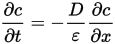
The negative sign indicates the ions are flowing from high concentration to low concentration. In this equation, D is the diffusion coefficient for the lithium ion. It has a value of 7.5 × 10⁻¹⁰ m/s in the LiPF
6 electrolyte. The value for ε, the porosity of the electrolyte, is 0.724.[116]
Uses
Li-ion batteries provide lightweight, high energy density power sources for a variety of devices. To power larger devices, such as electric cars, connecting many small batteries in a parallel circuit is more effective[117] and more efficient than connecting a single large battery. Such devices include:
- Portable devices: these include mobile phones and smartphones, laptops and tablets, digital cameras and camcorders, electronic cigarettes, handheld game consoles and torches (flashlights).
- Power tools: Li-ion batteries are used in tools such as cordless drills, sanders, saws and a variety of garden equipment including whipper-snippers and hedge trimmers.
- Electric vehicles: Because of their light weight Li-ion batteries are used for propelling a wide range of electric vehicles such as aircraft,[118][119][120] electric cars,[121] Pedelecs, hybrid vehicles, advanced electric wheelchairs, radio-controlled models, model aircraft and the Mars Curiosity rover.
Li-ion batteries are used in telecommunications applications. Secondary non-aqueous lithium batteries provide reliable backup power to load equipment located in a network environment of a typical telecommunications service provider. Li-ion batteries compliant with specific technical criteria are recommended for deployment in the Outside Plant (OSP) at locations such as Controlled Environmental Vaults (CEVs), Electronic Equipment Enclosures (EEEs), and huts, and in uncontrolled structures such as cabinets. In such applications, li-ion battery users require detailed, battery-specific hazardous material information, plus appropriate fire-fighting procedures, to meet regulatory requirements and to protect employees and surrounding equipment.[122]
Self-discharge

Batteries gradually self-discharge even if not connected and delivering current. Li+ rechargeable batteries have a self-discharge rate typically stated by manufacturers to be 1.5-2% per month.[123][124] The rate increases with temperature and state of charge. A 2004 study found that for most cycling conditions self-discharge was primarily time-dependent; however, after several months of stand on open circuit or float charge, state-of-charge dependent losses became significant. The self-discharge rate did not increase monotonically with state-of-charge, but dropped somewhat at intermediate states of charge.[125] Self-discharge rates may increase as batteries age.[126]
For comparison, the self-discharge rate is over 30% per month for common nickel metal hydride (NiMH) batteries,[127] dropping to about 1.25% per month for low self-discharge NiMH batteries, and 10% per month in nickel-cadmium batteries.
Battery life
Rechargeable battery life is typically defined as the number of full charge-discharge cycles before significant capacity loss. Storage also reduces capacity.
Manufacturers' information typically specify lifespan in terms of the number of cycles (e.g., capacity dropping linearly to 80% over 500 cycles), with no mention of chronological age.[128] Research rejects this common industry practice. On average, lifetimes consist of 1000 cycles,[129] although battery performance is rarely specified for more than 500 cycles. This means that batteries of mobile phones, or other hand-held devices in daily use, are not expected to last longer than three years. Some batteries based on carbon anodes offer more than 10,000 cycles.[130]
As a battery self-discharges, its voltage gradually diminishes. When depleted below the protection circuit's low-voltage threshold (2.4 to 2.9 V/cell, depending on chemistry) the circuit disconnects and stops discharging until recharged. As discharge progresses, metallic cell contents plate onto its internal structure, creating an unwanted discharge path.
Variability
A 2015 study by Andreas Gutsch of the Karlsruhe Institute of Technology found that lithium-ion battery storage lifetime could vary by a factor of five, with some Li-ion cells losing 30% of their capacity after 1,000 cycles, and others having better capacity after 5,000 cycles. The study also found that safety standards for some batteries were not met. For stationary energy storage it was estimated that batteries with lifespans of at least 3,000 cycles were needed for profitable operation.
Degradation
Over their lifespan, batteries degrade progressively with reduced capacity, cycle life, and safety due to chemical changes to the electrodes. Capacity loss/fade is expressed as a percentage of initial capacity after a number of cycles (e.g., 30% loss after 1,000 cycles). Fade can be separated into calendar loss and cycling loss. Calendar loss results from the passage of time and is measured from the maximum state of charge. Cycling loss is due to usage and depends on both the maximum state of charge and the depth of discharge.[77][131]
Degradation is strongly temperature-dependent; increasing if stored or used at higher temperatures. High charge levels and elevated temperatures (whether from charging or ambient air) hasten capacity loss.[91] Carbon anodes generate heat when in use. Batteries may be refrigerated to reduce temperature effects.[132]
Pouch and cylindrical cell temperatures depend linearly on the discharge current.[133] Poor internal ventilation may increase temperatures. Loss rates vary by temperature: 6% loss at 0 °C (32 °F), 20% at 25 °C (77 °F), and 35% at 40 °C (104 °F). In contrast, the calendar life of LiFePO
4 cells is not affected by high charge states.[134][135]
The advent of the SEI layer improved performance, but increased vulnerability to thermal degradation. The layer is composed of electrolyte – carbonate reduction products that serve both as an ionic conductor and electronic insulator. It forms on both the anode and cathode and determines many performance parameters. Under typical conditions, such as room temperature and the absence of charge effects and contaminants, after the first charge the layer reaches a fixed thickness, allowing the device can operate for years. However, operation outside such parameters can degrade the device via several reactions.[77]
Reactions
Five common exothermic degradation reactions can occur:[77]
- Chemical reduction of the electrolyte by the anode.
- Thermal decomposition of the electrolyte.
- Chemical oxidation of the electrolyte by the cathode.
- Thermal decomposition by the cathode and anode.
- Internal short circuit by charge effects.
Anode
The SEI layer that forms on the anode is a mixture of lithium oxide, lithium fluoride and semicarbonates (e.g., lithium alkyl carbonates).
At elevated temperatures, alkyl carbonates on the electrolyte decompose into insoluble Li
2CO
3 that can increase film thickness, clogging carbon surface pores and limiting ion anode access. This increases impedance and reduces capacity. Gases formed by electrolyte decomposition increase the cell's internal pressure and are a potential safety issue in demanding environments such as mobile devices.[77]
Extended storage can trigger an incremental increase in film thickness and capacity fade.[77]
Charging at greater than 4.2 V can initiate Li+ plating on the anode, producing irreversible capacity fade. The randomness of the metallic lithium embedded in the anode during intercalation results in dendrites formation. Over time the dendrites can accumulate and pierce the separator, causing a short circuit leading to heat, fire and/or explosion. This process is referred to as thermal runaway.[77]
Discharging beyond 2 V can also result in capacity fade. The (copper) anode current collector can dissolve into the electrolyte. When charged, copper ions can reduce on the anode as metallic copper. Over time, copper dendrites can form and cause a short in the same manner as lithium.[77]
In 2016 it was revealed via Wikileaks and other sources that a 4900mAh LiCoO2 cell was being used in military equipment, which overcomes the Cu dendrite issue by substituting gold (Au) as the anode and a classified alloy for the aluminium (needed for high current) cathode current collectors. Other improvements included the use of internal pressure sensors based on MEMS, electrolyte filtering and liquid cooling of the assemblies using SF6.
High cycling rates and state of charge induces mechanical strain on the anode's graphite lattice. Mechanical strain caused by intercalation and de-intercalation creates fissures and splits of the graphite particles, changing their orientation. This orientation change results in capacity fade.[77]
There is a historical note about the terminology of anode when referring to lithium cells, which started as primary (single discharge) as exemplified by lithium thionyl chloride cells. The anode is classically the electrode where oxidation is taking place in electrochemistry. This is true on discharge, but with a rechargeable system the electrode switches back and forth from anode to cathode with cycling. The less ambiguous term for secondary cells electrodes are positive (anode on charge, not discharge) and negative. This is the polarity measured on any cell with a volt meter.[77]
Electrolytes
Electrolyte degradation mechanisms include hydrolysis and thermal decomposition.[77]
At concentrations as low as 10 ppm, water begins catalyzing a host of degradation products that can affect the electrolyte, anode and cathode.[77] LiPF
6 participates in an equilibrium reaction with LiF and PF
5. Under typical conditions, the equilibrium lies far to the left. However the presence of water generates substantial LiF, an insoluble, electronically insulating product. LiF binds to the anode surface, increasing film thickness.[77]
LiPF
6 hydrolysis yields PF
5, a strong Lewis acid that reacts with electron-rich species, such as water. PF
5 reacts with water to form hydrofluoric acid (HF) and phosphorus oxyfluoride. Phosphorus oxyfluoride in turn reacts to form additional HF and difluorohydroxy phosphoric acid. HF converts the rigid SEI film into a fragile one. On the cathode, the carbonate solvent can then diffuse onto the cathode oxide over time, releasing heat and thermal runaway.[77]
Decomposition of electrolyte salts and interactions between the salts and solvent start at as low as 70 C. Significant decomposition occurs at higher temperatures. At 85 C transesterification products, such as dimethyl-2,5-dioxahexane carboxylate (DMDOHC) are formed from EC reacting with DMC.[77]
Cathode
Lithium cobalt oxide (LiCoO
2) is the most widely used cathode material. Lithium manganese oxide (LiMn2O
4) is a potential alternative because of its low cost and ease of preparation, but its relatively poor cycling and storage capabilities has prevented it from commercial acceptance.[77]
Cathode degradation mechanisms include manganese dissolution, electrolyte oxidation and structural disorder.[77]
In LiMnO
4 hydrofluoric acid catalyzes the loss of metallic manganese through disproportionation of trivalent manganese:[77]
2Mn3+ → Mn2++ Mn4+
Material loss of the spinel results in capacity fade. Temperatures as low as 50 C initiate Mn2+ deposition on the anode as metallic manganese with the same effects as lithium and copper plating. Cycling over the theoretical max and min voltage plateaus destroys the crystal lattice via Jahn-Teller distortion, which occurs when Mn4+ is reduced to Mn3+ during discharge.[77]
Storage of a battery charged to greater than 3.6 V initiates electrolyte oxidation by the cathode and induces SEI layer formation on the cathode. As with the anode, excessive SEI formation forms an insulator resulting in capacity fade and uneven current distribution.[77]
Storage at less than 2 V results in the slow degradation of LiCoO
2 and LiMn
2O
4 cathodes, the release of oxygen and irreversible capacity loss.[77]
Conditioning
The need to "condition" NiCd and NiMH batteries has leaked into folklore surrounding Li-ion batteries. The recommendation for the older technologies is to leave the device plugged in for seven or eight hours, even if fully charged.[136] This may be a confusion of battery software calibration instructions with the "conditioning" instructions for NiCd and NiMH batteries.[137]
Multicell devices
Li-ion batteries require a battery management system to prevent operation outside each cell's safe operating area (max-charge, min-charge, safe temperature range) and to balance cells to eliminate state of charge mismatches. This significantly improves battery efficiency and increases capacity. As the number of cells and load currents increase, the potential for mismatch increases. The two kinds of mismatch are state-of-charge (SOC) and capacity/energy ("C/E"). Though SOC is more common, each problem limits pack charge capacity (mA·h) to that of the weakest cell.
Safety
If overheated or overcharged, Li-ion batteries may suffer thermal runaway and cell rupture.[138][139] In extreme cases this can lead to combustion. To reduce these risks, lithium-ion battery packs contain fail-safe circuitry that disconnects the battery when its voltage is outside the safe range of 3–4.2 V per cell.[72][127] Lithium-ion cells are very susceptible to damage outside the allowed voltage range that is typically within (2.5 to 3.65) V for most LFP cells. Exceeding this voltage range results in premature aging of the cells and, furthermore, results in safety risks due to the reactive components in the cells.[140] When stored for long periods the small current draw of the protection circuitry may drain the battery below its shutoff voltage; normal chargers may then be useless. Many types of lithium-ion cells cannot be charged safely below 0 °C.[141]
Other safety features are required in each cell:[72]
- Shut-down separator (for overheating)
- Tear-away tab (for internal pressure)
- Vent (pressure relief)
- Thermal interrupt (overcurrent/overcharging)
These features are required because the negative electrode produces heat during use, while the positive electrode may produce oxygen. However, these additional devices occupy space inside the cells, add points of failure, and irreversibly disable the cell when activated. Further, these features increase costs compared to nickel metal hydride batteries, which require only a hydrogen/oxygen recombination device and a back-up pressure valve.[142] Contaminants inside the cells can defeat these safety devices. Also, these features can not be applied to all kinds of cells, e.g. prismatic high current cells can not be equipped with a vent or thermal interrupt. High current cells must not produce any excessive heat or oxygen. Instead they must be equipped with internal thermal fuses which act before the anode and cathode reaches their thermal runaway limits.
Short-circuiting a battery will cause the cell to overheat and possibly to catch fire. Adjacent cells may then overheat and fail, possibly causing the entire battery to ignite or rupture. In the event of a fire, the device may emit dense irritating smoke.[143] The fire energy content (electrical + chemical) of cobalt-oxide cells is about 100 to 150 kJ/(A·h), most of it chemical.[66][144]
Replacing the lithium cobalt oxide positive electrode material in lithium-ion batteries with a lithium metal phosphate such as lithium iron phosphate improves cycle counts, shelf life and safety, but lowers capacity. As of 2006 these 'safer' lithium-ion batteries were mainly used in electric cars and other large-capacity battery applications, where safety is critical.[145]
Lithium-ion batteries, unlike other rechargeable batteries, have a potentially hazardous pressurised flammable electrolyte, and require strict quality control during manufacture.[146] A faulty battery can cause a serious fire. Faulty chargers can affect the safety of the battery because they can destroy the battery's protection circuit. While charging at temperatures below 0 °C, the negative electrode of the cells gets plated with pure lithium, which can compromise the safety of the whole pack.
While fire is often serious, it may be catastrophically so. In about 2010 large lithium-ion batteries were introduced in place of other chemistries to power systems on some aircraft; as of January 2014 there had been at least four serious lithium-ion battery fires, or smoke, on the Boeing 787 passenger aircraft, introduced in 2011, which did not cause crashes but had the potential to do so.[147][148]
In addition, several aircraft crashes have been attributed to burning Li-Ion batteries. UPS Airlines Flight 6 crashed in Dubai after its payload of batteries spontaneously ignited, progressively destroying critical systems inside the aircraft which eventually rendered it uncontrollable.
Environmental concerns and recycling
Since Li-ion batteries contain less toxic metals than other types of batteries which may contain lead or cadmium[72] they are generally categorized as non-hazardous waste. Li-ion battery elements including iron, copper, nickel and cobalt are considered safe for incinerators and landfills. These metals can be recycled,[149][150] but mining generally remains cheaper than recycling.[151] At present, not much is invested into recycling Li-ion batteries due to costs, complexities and low yield. The most expensive metal involved in the construction of the cell is cobalt. Lithium iron phosphate is cheaper but has other drawbacks. Lithium is less expensive than other metals used, but recycling could prevent a future shortage.[149] The manufacturing processes of nickel and cobalt for the positive electrode and also the solvent, present potential environmental and health hazards.[152][153] Manufacturing a kg of Li-ion battery takes energy equivalent to 1.6 kg of oil.[154]
Recalls
In October 2004 Kyocera Wireless recalled approximately 1 million mobile phone batteries to identify counterfeits.[155]
In December 2005 Dell recalled approximately 22,000 laptop computer batteries, and 4.1 million in August 2006.[156] Approximately 10 million Sony batteries used in Dell, Sony, Apple, Lenovo, Panasonic, Toshiba, Hitachi, Fujitsu and Sharp laptops were recalled in 2006. The batteries were found to be susceptible to internal contamination by metal particles during manufacture. Under some circumstances, these particles could pierce the separator, causing a dangerous short-circuit.[157]
In March 2007 computer manufacturer Lenovo recalled approximately 205,000 batteries at risk of explosion. In August 2007 mobile phone manufacturer Nokia recalled over 46 million batteries at risk of overheating and exploding.[158] One such incident occurred in the Philippines involving a Nokia N91, which used the BL-5C battery.[159]
In September 2016 Samsung recalled approximately 2.5 million Galaxy Note 7 phones after 35 confirmed fires.[160] The recall was due to a manufacturing fault in Samsung's batteries which cause the positive and negative poles to come into contact.[161]
Transport restrictions
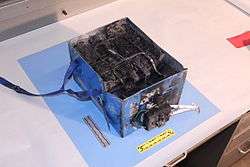
IATA estimates that over a billion lithium cells are flown each year.[144]
The maximum size of each battery (whether installed in a device or as spare batteries) that can be carried is one that has an equivalent lithium content (ELC) not exceeding 8 grammes per battery. Except, that if only one or two batteries are carried, each may have an ELC of not more than 25 grammes each.[162] The ELC for any battery is found by multiplying the ampere-hour capacity of each cell by 0.3 and then multiplying the result by the number of cells in the battery.[162] The resultant calculated lithium content is not the actual lithium content but a theoretical figure solely for transportation purposes. When shipping lithium ion batteries however, if the total lithium content in the cell exceeds 1.5 g, the package must be marked as "Class 9 miscellaneous hazardous material".
Although devices containing lithium-ion batteries may be transported in checked baggage, spare batteries may be only transported in carry-on baggage.[162] They must be protected against short circuiting, and example tips are provided in the transport regulations on safe packaging and carriage; e.g., such batteries should be in their original protective packaging or, "by taping over the exposed terminals or placing each battery in a separate plastic bag or protective pouch".[162][163] These restriction do not apply to a lithium-ion battery that is a part of a wheelchair or mobility aid (including any spare batteries) to which a separate set of rules and regulations apply.[162]
Some postal administrations restrict air shipping (including EMS) of lithium and lithium-ion batteries, either separately or installed in equipment. Such restrictions apply in Hong Kong,[164] Australia and Japan.[165] Other postal administrations, such as the United Kingdom's Royal Mail may permit limited carriage of batteries or cells that are operative but totally prohibit handling of known defective ones, which is likely to prove of significance to those discovering faulty such items bought through mail-order channels.[166] The IATA provides details in its Lithium Battery Guidance document which the Royal Mail makes available.
On 16 May 2012, the United States Postal Service (USPS) banned shipping anything containing a lithium battery to an overseas address, after fires from transport of batteries.[167] This restriction made it difficult to send anything containing lithium batteries to military personnel overseas, as the USPS was the only method of shipment to these addresses; the ban was lifted on 15 November 2012.[168] United Airlines and Delta Air Lines excluded lithium-ion batteries in 2015 after an FAA report on chain reactions.[169][170][171]
The Boeing 787 Dreamliner uses large lithium cobalt oxide[172] batteries, which are more reactive than newer types of batteries such as LiFePO
4.[173]
Research
Researchers are working to improve the research methods, power density, safety, cycle durability, recharge time, cost, flexibility, and other characteristics of these batteries. Researchers at IBM India have come up with an experimental power supply using lithium-ion cells from discarded laptop battery packs for use in unelectrified regions in developing nations.[174]
See also
- Aluminium-ion battery
- List of battery sizes
- List of battery types
- Comparison of battery types
- List of energy densities
- Lithium as an investment
- Lithium battery
- Lithium ion manganese oxide battery
- Lithium iron phosphate battery
- Lithium polymer battery
- Lithium sulfur battery
- Lithium titanate battery
- Lithium vanadium phosphate battery
- Lithium-ion flow battery
- Lithium–air battery
- Lithium–silicon battery
- Nanotechnology
- Nanowire battery
- Potassium-ion battery
- Research in lithium-ion batteries
- Solid-state lithium-ion battery
- UPS Airlines Flight 6, crashed, fire caused by Lithium-ion batteries
References
- 1 2 3 "Rechargeable Li-Ion OEM Battery Products". Panasonic.com. Archived from the original on 13 April 2010. Retrieved 23 April 2010.
- 1 2 "Panasonic Develops New Higher-Capacity 18650 Li-Ion Cells; Application of Silicon-based Alloy in Anode". greencarcongress.com. Retrieved 31 January 2011.
- ↑ "NCR18650B" (PDF). Panasonic. Retrieved 7 October 2016.
- ↑ Valøen, Lars Ole and Shoesmith, Mark I. (2007). The effect of PHEV and HEV duty cycles on battery and battery pack performance (PDF). 2007 Plug-in Highway Electric Vehicle Conference: Proceedings. Retrieved 11 June 2010.
- ↑ Lawson Barrie Electrochemical Energy Woodbank Communications Ltd
- ↑ Abe, H.; Murai, T.; Zaghib, K. (1999). "Vapor-grown carbon fiber anode for cylindrical lithium ion rechargeable batteries". Journal of Power Sources. 77 (2): 110–115. doi:10.1016/S0378-7753(98)00158-X.
- ↑ Battery Types and Characteristics for HEV ThermoAnalytics, Inc., 2007. Retrieved 11 June 2010.
- ↑ "Memory effect now also found in lithium-ion batteries". Retrieved 5 August 2015.
- ↑ Ballon, Massie Santos (14 October 2008). "Electrovaya, Tata Motors to make electric Indica". cleantech.com. Archived from the original on 9 May 2011. Retrieved 11 June 2010.
- ↑ Millsaps, C. (10 July 2012). Second Edition of IEC 62133: The Standard for Secondary Cells and Batteries Containing Alkaline or Other Non-Acid Electrolytes is in its Final Review Cycle. Retrieved from Battery Power Online (10 January 2014)
- 1 2 IEC 62133. Secondary cells and batteries containing alkaline or other non-acid electrolytes – Safety requirements for portable sealed secondary cells, and for batteries made from them, for use in portable applications (2.0 ed.). International Electrotechnical Commission. December 2012. ISBN 978-2-83220-505-1.
- ↑ IEC 61960. Secondary cells and batteries containing alkaline or other non-acid electrolytes – Secondary lithium cells and batteries for portable applications (2.0 ed.). International Electrotechnical Commission. June 2011. ISBN 978-2-88912-538-8.
- ↑ ISO 12405-1:2011. Electrically propelled road vehicles — Test specification for lithium-ion traction battery packs and systems. Part 1: High-power applications. International Organization for Standardization. 2011. ISBN 978-0-580-62648-7.
- 1 2 Doughty, Daniel H.; Crafts, Chris C. (August 2006). SAND 2005–3123. FreedomCAR Electrical Energy Storage System Abuse Test Manual for Electric and Hybrid Electric Vehicle Applications. Sandia National Laboratories.
- 1 2 Matthe, Roland; Eberle, Ulrich (2014-01-01). "The Voltec System - Energy Storage and Electric Propulsion". Retrieved 2014-05-04.
- ↑ Whittingham, M. S. (1976). "Electrical Energy Storage and Intercalation Chemistry". Science. 192 (4244): 1126–1127. doi:10.1126/science.192.4244.1126. PMID 17748676.
- ↑ Fletcher, Seth (2011). Bottled Lightning: Superbatteries, Electric Cars, and the New Lithium Economy. Macmillan.
- ↑ "XXIV.—On chemical analysis by spectrum-observations". Quarterly Journal of the Chemical Society of London. 13 (3): 270. 1861. doi:10.1039/QJ8611300270.
- ↑ Besenhard, J.O. & Fritz, H.P. (1974). "Cathodic Reduction of Graphite in Organic Solutions of Alkali and NR4+ Salts". J. Electroanal. Chem. 53 (2): 329–333. doi:10.1016/S0022-0728(74)80146-4.
- ↑ Besenhard, J. O. (1976). "The electrochemical preparation and properties of ionic alkali metal-and NR4-graphite intercalation compounds in organic electrolytes". Carbon. 14 (2): 111–115. doi:10.1016/0008-6223(76)90119-6.
- ↑ Schöllhorn, R.; Kuhlmann, R.; Besenhard, J. O. (1976). "Topotactic redox reactions and ion exchange of layered MoO3 bronzes". Materials Research Bulletin. 11: 83–90. doi:10.1016/0025-5408(76)90218-X.
- ↑ Besenhard, J. O.; Schöllhorn, R. (1976). "The discharge reaction mechanism of the MoO3 electrode in organic electrolytes". Journal of Power Sources. 1 (3): 267–276. doi:10.1016/0378-7753(76)81004-X.
- ↑ Besenhard, J. O.; Eichinger, G. (1976). "High energy density lithium cells". Journal of Electroanalytical Chemistry and Interfacial Electrochemistry. 68: 1–18. doi:10.1016/S0022-0728(76)80298-7.
- ↑ Eichinger, G.; Besenhard, J. O. (1976). "High energy density lithium cells". Journal of Electroanalytical Chemistry and Interfacial Electrochemistry. 72: 1–31. doi:10.1016/S0022-0728(76)80072-1.
- ↑ Heller, Adam (25 November 1975). "Electrochemical Cell". United States Patent. Retrieved 18 November 2013.
- ↑ Zanini, M.; Basu, S.; Fischer, J. E. (1978). "Alternate synthesis and reflectivity spectrum of stage 1 lithium—graphite intercalation compound". Carbon. 16 (3): 211–212. doi:10.1016/0008-6223(78)90026-X.
- ↑ Basu, S.; Zeller, C.; Flanders, P. J.; Fuerst, C. D.; Johnson, W. D.; Fischer, J. E. (1979). "Synthesis and properties of lithium-graphite intercalation compounds". Materials Science and Engineering. 38 (3): 275–283. doi:10.1016/0025-5416(79)90132-0.
- ↑ US 4304825, Basu; Samar, "Rechargeable battery", issued 8 December 1981, assigned to Bell Telephone Laboratories
- ↑ N. A. Godshall, I. D. Raistrick, and R. A. Huggins, Journal of the Electrochemical Society, Abstract 162, Vol. 126, p. 322C; "Thermodynamic Investigations of Ternary Lithium-Transition Metal-Oxide Systems for Lithium Batteries" (August 1979).
- ↑ N. A. Godshall, I. D. Raistrick, and R. A. Huggins, Journal of the Electrochemical Society, Extended Abstract 162, Vol. 79-2, pp. 420-422; Thermodynamic Investigations of Ternary Lithium-Transition Metal-Oxide Systems for Lithium Batteries" (October 1979).
- ↑ Ned A. Godshall, "Electrochemical and Thermodynamic Investigation of Ternary Lithium -Transition Metal-Oxide Cathode Materials for Lithium Batteries: Li2MnO4 spinel, LiCoO2, and LiFeO2", Presentation at 156th Meeting of the Electrochemical Society, Los Angeles, CA, (17 October 1979).
- ↑ N. A. Godshall, I. D. Raistrick, and R. A. Huggins, Materials Research Bulletin, 15(5), pp.561-570 (May 1980) "Thermodynamic Investigations of Ternary Lithium-Transition Metal-Oxygen Cathode Materials for Lithium Batteries". doi: 10.1016/0025-5408(80)90135-X
- ↑ Ned A. Godshall, Ph.D. Dissertation, Stanford University (published 18 May 1980) "Electrochemical and Thermodynamic Investigation of Ternary Lithium-Transition Metal-Oxygen Cathode Materials for Lithium Batteries".
- ↑ "USPTO search for inventions by "Goodenough, John"". Patft.uspto.gov. Retrieved 8 October 2011.
- ↑ Mizushima, K.; Jones, P. C.; Wiseman, P. J.; Goodenough, J. B. (1980). "Li
xCoO
2(0<x<-1): A new cathode material for batteries of high energy density". Materials Research Bulletin. 15 (6): 783–789. doi:10.1016/0025-5408(80)90012-4. - ↑ Ned A. Godshall, Proceedings of the 5th International Conference on Solid State Ionics, Part II, p. 788, North Holland, "Lithium Transport in Ternary Lithium-Copper-Oxygen Cathode materials for Reversible Lithium Batteries" (1985)
- ↑ N.A. Godshall, Presented at the 5th International Conference in Solid State Ionics, Lake Tahoe CA, 21 August 1985, "Lithium Transport in Ternary Lithium-Copper-Oxygen Cathode Materials".
- ↑ International Meeting on Lithium Batteries, Rome, 27–29 April 1982, C.L.U.P. Ed. Milan, Abstract #23
- ↑ Yazami, R.; Touzain, P. (1983). "A reversible graphite-lithium negative electrode for electrochemical generators". Journal of Power Sources. 9 (3): 365–371. doi:10.1016/0378-7753(83)87040-2.
- ↑ N. A. Godshall, I. D. Raistrick, and R. A. Huggins, U.S. Patent #4,340,652 issued July 20, 1982; "Ternary Compound Electrode for Lithium Cells"; filed by Stanford University on July 30, 1980 and Assigned to the United States of America.
- ↑ Thackeray, M. M.; David, W. I. F.; Bruce, P. G.; Goodenough, J. B. (1983). "Lithium insertion into manganese spinels". Materials Research Bulletin. 18 (4): 461–472. doi:10.1016/0025-5408(83)90138-1.
- ↑ Nazri, Gholamabbas & Pistoia, Gianfranco (2004). Lithium batteries: science and Technology. Springer. ISBN 1402076282.
- 1 2 Voelcker, John (September 2007). Lithium Batteries Take to the Road. IEEE Spectrum. Retrieved 15 June 2010.
- ↑ US 4668595, Yoshino; Akira, "Secondary Battery", issued 10 May 1985, assigned to Asahi Kasei
- ↑ Manthiram, A.; Goodenough, J. B. (1989). "Lithium insertion into Fe2(SO4)3 frameworks". Journal of Power Sources. 26 (3–4): 403–408. doi:10.1016/0378-7753(89)80153-3.
- ↑ Armand, M.; Touzain, P. (1977). "Graphite intercalation compounds as cathode materials". Material Science and Engineering. 31: 319–329. doi:10.1016/0025-5416(77)90052-0. Retrieved 2016-06-15.
- ↑ Novak, P.; Muller, K.; Santhanam, K. S. V.; Haas, O. (1997). "Electrochemically Active Polymers for Rechargeable Batteries". Chem. Rev. 97 (1): 207–281. doi:10.1021/cr941181o. Retrieved 2016-06-15.
- ↑ Yamabe, T. (2015). "Lichiumu Ion Niji Denchi: Kenkyu Kaihatu No Genryu Wo Kataru" [Lithium Ion Rechargeable Batteries: Tracing the Origins of Research and Development: Focus on the History of Negative-Electrode Material Development]. The journal Kagaku (in Japanese). 70 (12): 40–46. Retrieved 2016-06-15.
- ↑ Novak, P.; Muller, K.; Santhanam, K. S. V.; Haas, O. (1997). "op.cit.". Chem. Rev. 97 (1): 271–272. doi:10.1021/cr941181o. Retrieved 2016-06-15.
- ↑ Yamabe, T.; Tanaka, K.; Ohzeki, K.; Yata, S. (1982). "Electronic Structure of Polyacenacene. A One-Dimensional Graphite". Solid State Communications. 44 (6): 823. doi:10.1016/0038-1098(82)90282-4.
- ↑ US 4601849, Yata, S., "Electrically conductive organic polymeric material and process for production thereof"
- ↑ Nigrey et al. (1981). "Lightweight Rechargeable Storage Batteries Using Polyacetylene (CH)x as the Cathode-Active Material". Chem. Rev. 128 (8): 1651. doi:10.1149/1.2127704. Retrieved 2016-06-15.
- ↑ "Keywords to understanding Sony Energy Devices".
- ↑ "LiFePO4: a novel cathode material for rechargeable batteries".
- ↑ Chung, S. Y.; Bloking, J. T.; Chiang, Y. M. (2002). "Electronically conductive phospho-olivines as lithium storage electrodes". Nature Materials. 1 (2): 123–128. doi:10.1038/nmat732. PMID 12618828.
- 1 2 "In search of the perfect battery" (PDF). The Economist. 6 March 2008. Archived from the original (PDF) on 27 July 2011. Retrieved 11 May 2010.
- ↑ Monthly battery sales statistics. Machinery statistics released by the Ministry of Economy, Trade and Industry, March 2011.
- ↑ "At long last, new lithium battery tech actually arrives on the market (and might already be in your smartphone)". ExtremeTech. Retrieved 16 February 2014.
- ↑ "Lithium Ion Battery Pioneers Receive Draper Prize, Engineering’s Top Honor", University of Texas, 6 January 2014
- 1 2 http://www.batteriesconsumerlitigation.com/documents/Amended%20Class%20Action%20Complaint.pdf
- ↑ http://www.batteriesconsumerlitigation.com/documents/Settlement%20Agreement.pdf
- ↑ Silberberg, M. (2006). Chemistry: The Molecular Nature of Matter and Change, 4th Ed. New York (NY): McGraw-Hill Education. p. 935, ISBN 0077216504.
- ↑ Thackeray, M. M.; Thomas, J. O.; Whittingham, M. S. (2011). "Science and Applications of Mixed Conductors for Lithium Batteries". MRS Bulletin. 25 (3): 39–46. doi:10.1557/mrs2000.17.
- ↑ Shehzad, Khurram; Xu, Yang; Gao, Chao; Xianfeng, Duan (2016). "Three-dimensional macro-structures of two-dimensional nanomaterials". Chemical Society Reviews. doi:10.1039/C6CS00218H. Retrieved 4 October 2016.
- ↑ MSDS: National Power Corp Lithium Ion Batteries (PDF). tek.com; Tektronix Inc., 7 May 2004. Retrieved 11 June 2010.
- 1 2 3 "How to rebuild a Li-Ion battery pack" (PDF). Electronics Lab. Archived from the original on 3 January 2012. Retrieved 29 Oct 2016.
- ↑ Goodwins, Rupert (17 August 2006). "Inside a notebook battery pack". ZDNet. Retrieved 6 June 2013.
- ↑ Andrea 2010, p. 2.
- ↑ Andrea 2010, p. 234.
- ↑ Wang, Y.; He, P.; Zhou, H. (2012). "Li-Redox Flow Batteries Based on Hybrid Electrolytes: At the Cross Road between Li-ion and Redox Flow Batteries". Advanced Energy Materials. 2 (7): 770–779. doi:10.1002/aenm.201200100.
- ↑ Panasonic unveils 'smallest' pin-shaped lithium ion battery, Telecompaper, 6 October 2014
- 1 2 3 4 "Lithium Ion technical handbook" (PDF). Gold Peak Industries Ltd. November 2003. Archived from the original (PDF) on 7 October 2007.
- ↑ Choi, H. C.; Jung, Y. M.; Noda, I.; Kim, S. B. (2003). "A Study of the Mechanism of the Electrochemical Reaction of Lithium with CoO by Two-Dimensional Soft X-ray Absorption Spectroscopy (2D XAS), 2D Raman, and 2D Heterospectral XAS−Raman Correlation Analysis". The Journal of Physical Chemistry B. 107 (24): 5806–5811. doi:10.1021/jp030438w.
- ↑ Amatucci, G. G. (1996). "CoO
2, the End Member of the Li
xCoO
2 Solid Solution". Journal of the Electrochemical Society. 143 (3): 1114–1110. doi:10.1149/1.1836594. - ↑ Younesi, Reza; Veith, Gabriel M.; Johansson, Patrik; Edström, Kristina; Vegge, Tejs (2015). "Lithium salts for advanced lithium batteries: Li–metal, Li–O 2 , and Li–S". Energy Environ. Sci. 8 (7): 1905–1922. doi:10.1039/c5ee01215e.
- ↑ Wenige, Niemann, et al. (30 May 1998). Liquid Electrolyte Systems for Advanced Lithium Batteries (PDF). cheric.org; Chemical Engineering Research Information Center(KR). Retrieved 11 June 2010.
- 1 2 3 4 5 6 7 8 9 10 11 12 13 14 15 16 17 18 19 20 21 Voelker, Paul (2014-04-22). "Trace Degradation Analysis of Lithium-Ion Battery Components". R&D. Retrieved 4 April 2015.
- ↑ Balbuena, P.B., Wang, Y.X. (eds) (2004). Lithium Ion Batteries: Solid Electrolyte Interphase, Imperial College Press, London. ISBN 1860943624.
- ↑ Fong, R. A. (1990). "Studies of Lithium Intercalation into Carbons Using Nonaqueous Electrochemical Cells". Journal of the Electrochemical Society. 137 (7): 2009–2010. doi:10.1149/1.2086855.
- ↑ Syzdek, J. A.; Borkowska, R.; Perzyna, K.; Tarascon, J. M.; Wieczorek, W. A. A. (2007). "Novel composite polymeric electrolytes with surface-modified inorganic fillers". Journal of Power Sources. 173 (2): 712–720. doi:10.1016/j.jpowsour.2007.05.061.
- ↑ Syzdek, J. A.; Armand, M.; Marcinek, M.; Zalewska, A.; Żukowska, G. Y.; Wieczorek, W. A. A. (2010). "Detailed studies on the fillers modification and their influence on composite, poly(oxyethylene)-based polymeric electrolytes". Electrochimica Acta. 55 (4): 1314–1322. doi:10.1016/j.electacta.2009.04.025.
- ↑ Reiter, J.; Nádherná, M.; Dominko, R. (2012). "Graphite and LiCo1/3Mn1/3Ni1/3O2 electrodes with piperidinium ionic liquid and lithium bis(fluorosulfonyl)imide for Li-ion batteries". Journal of Power Sources. 205: 402–407. doi:10.1016/j.jpowsour.2012.01.003.
- ↑ Linden, David and Reddy, Thomas B. (eds.) (2002). Handbook of Batteries 3rd Edition. McGraw-Hill, New York. chapter 35. ISBN 0-07-135978-8.
- ↑ "Design Review For: Advanced Electric Vehicle Battery Charger, ECE 445 Senior Design Project". 090521 courses.ece.illinois.edu. Archived from the original on 4 May 2013.
- 1 2 "Lithium Ion Rechargeable Batteries. Technical Handbook" (PDF). Archived from the original (PDF) on 11 April 2009.
- ↑ Siemens CL75 user manual. Siemens AG. 2005. p. 8.
- ↑ Fisher, Thomas. "Will Tesla Alone Double Global Demand For Its Battery Cells? (Page 2)". Greencarreports.com. Retrieved 16 February 2014.
- ↑ "Reduced cell cost suggests the upcoming era of large capacity cells". EnergyTrend. 6 May 2013. Retrieved 16 February 2014.
- ↑ Ramsey, Mike (2015-06-22). "24M Technologies Launches Cheaper-to-Produce Lithium-Ion Cell". Retrieved 2015-12-15.
- ↑ "Overview of lithium ion batteries" (PDF). Panasonic. Jan 2007. Archived (PDF) from the original on 7 November 2011.
- 1 2 3 Winter & Brodd 2004, p. 4258
- ↑ Andrea 2010, p. 12.
- ↑ Turpen, Aaron (November 16, 2015). "New battery tech gives 10 hours of talk time after only 5 minutes on charge". www.gizmag.com. Retrieved 2015-12-03.
- ↑ Smith, Noah (16 January 2015). "Get Ready For Life Without Oil". bloombergview.com. Retrieved 31 July 2015.
- 1 2 "Lithium-Ion Batteries". Sigma Aldrich. Sigma Aldrich.
- 1 2 Nitta, Naoki; Wu, Feixiang; Lee, Jung Tae; Yushin, Gleb (2015). "Li-ion battery materials: present and future". MaterialsToday. 18 (5): 252–264. doi:10.1016/j.mattod.2014.10.040.
- ↑ Fergus, Jeffrey (2010). "Recent developments in cathode materials for lithium ion batteries". Journal of Power Sources. 195 (4): 939–954. doi:10.1016/j.jpowsour.2009.08.089.
- ↑ "Imara Corporation website". Imaracorp.com. Archived from the original on 22 July 2009. Retrieved 8 October 2011.
- ↑ O'Dell, John (17 December 2008). Fledgling Battery Company Says Its Technology Boosts Hybrid Battery Performance Green Car Advisor; Edmunds Inc. Retrieved 11 June 2010.
- ↑ Jost, Kevin [ed.] (October 2006). Tech Briefs: CPI takes new direction on Li-ion batteries (PDF). aeionline.org; Automotive Engineering Online.
- ↑ Loveday, Eric (23 April 2010). "Hitachi develops new manganese cathode, could double life of li-ion batteries". Retrieved 11 June 2010.
- ↑ Nikkei (29 November 2009). Report: Nissan On Track with Nickel Manganese Cobalt Li-ion Cell for Deployment in 2015 Green Car Congress (blog). Retrieved 11 June 2010.
- ↑ EnerDel Technical Presentation (PDF). EnerDel Corporation. 29 October 2007..
- ↑ Elder, Robert and Zehr, Dan (16 February 2006). Valence sued over UT patent Austin American-Statesman (courtesy Bickle & Brewer Law Firm)..
- ↑ Bulkeley, William M. (26 November 2005). "New Type of Battery Offers Voltage Aplenty, at a Premium". The Day. p. E6.
- ↑ A123Systems (2 November 2005). A123Systems Launches New Higher-Power, Faster Recharging Li-Ion Battery Systems Green Car Congress; A123Systems (Press release). Retrieved 11 May 2010.
- ↑ "A Better Anode Design to Improve Lithium-Ion Batteries". Berkeley Lab: Lawrence Berkeley National Laboratory.
- ↑ "Northwestern researchers advance Li-ion batteries with graphene-silicon sandwich | Solid State Technology". Electroiq.com. November 2011.
Zhao, X.; Hayner, C. M.; Kung, M. C.; Kung, H. H. (2011). "In-Plane Vacancy-Enabled High-Power Si-Graphene Composite Electrode for Lithium-Ion Batteries". Advanced Energy Materials. 1 (6): 1079–1084. doi:10.1002/aenm.201100426. - ↑ "... Acceptance of the First Grid-Scale, Battery Energy Storage System" (Press release). Altair Nanotechnologies. 21 November 2008. Retrieved 8 October 2009.
- ↑ Ozols, Marty (11 November 2009). Altair Nanotechnologies Power Partner – The Military. Systemagicmotives (personal webpage). Retrieved 11 June 2010.
- ↑ Gotcher, Alan J. (29 November 2006). "Altair EDTA Presentation" (PDF). Altairnano.com. Archived from the original (PDF) on 16 June 2007.
- ↑ Synthetic Carbon Negative electrode Boosts Battery Capacity 30 Percent | MIT Technology Review. Technologyreview.com (2 April 2013). Retrieved 16 April 2013.
- ↑ Newman, Jared (23 May 2013). "Amprius Begins Shipping a Better Smartphone Battery". Time. Retrieved 4 June 2013.
- ↑ http://pubs.acs.org/doi/pdf/10.1021/jz3006892
- ↑ http://pubs.acs.org/doi/pdf/10.1021/jz3006892
- ↑ Summerfield, J. (2013). "Modeling the Lithium Ion Battery". Journal of Chemical Education. 90 (4): 453–455. doi:10.1021/ed300533f.
- ↑ Andrea 2010, p. 229.
- ↑ "Silent 2 Electro". Alisport. Retrieved 6 December 2014.
- ↑ "Pipistrel web site". Retrieved 6 December 2014.
- ↑ [http://www.schempp-hirth.com/index.php?id=126&L=1&tx_ttnews[tt_news]=640&tx_ttnews[backPid]=130&cHash=745a0119cc "Ventus-2cxa with FES propulsion system"]. Schempp-Hirth.
- ↑ Miller, Peter (10 January 2015). "Automotive Lithium-Ion Batteries". Johnson Matthey Technology Review. 59 (1): 4–13. doi:10.1595/205651315x685445.
- ↑ GR-3150-CORE, Generic Requirements for Secondary Non-Aqueous Lithium Batteries.
- ↑ Sanyo: Overview of Lithium Ion Batteries Archived 3 March 2016 at the Wayback Machine., listing self-discharge rate of 2%/mo
- ↑ Sanyo: Harding energy specification Archived 27 December 2015 at the Wayback Machine., listing self-discharge rate of 0.3%/mo
- ↑ Zimmerman, A. H. (2004). "Self-discharge losses in lithium-ion cells". IEEE Aerospace and Electronic Systems Magazine. 19 (2): 19–24. doi:10.1109/MAES.2004.1269687.
- ↑ Phil Weicker (1 November 2013). A Systems Approach to Lithium-Ion Battery Management. Artech House. p. 214. ISBN 978-1-60807-659-8.
- 1 2 Winter & Brodd 2004, p. 4259
- ↑ Specification sheet for typical lithium-ion battery. industrial.panasonic.com
- ↑ "How Lithium-ion Batteries Work". howstuffworks.com.
- ↑ Untersuchungen von Polarisationseffekte an Lithium-Ionen-Batterien In: Promotion Dr. Marcel Wilka 19. Dezember 2013.
- ↑ Waldmann, T.; Wilka, M.; Kasper, M.; Fleischhammer, M.; Wohlfahrt-Mehrens, M. (2014). "Temperature dependent ageing mechanisms in Lithium-ion batteries – A Post-Mortem study". Journal of Power Sources. 262: 129–135. doi:10.1016/j.jpowsour.2014.03.112.
- ↑ Cristo, L.M. & Atwater, T. B. Characteristics and Behavior of 1M LiPF6 1EC:1DMC Electrolyte at Low Temperatures. Fort Monmouth, NJ: U.S. Army Research.
- ↑ Waldmann, T.; Bisle, G.; Hogg, B. -I.; Stumpp, S.; Danzer, M. A.; Kasper, M.; Axmann, P.; Wohlfahrt-Mehrens, M. (2015). "Influence of Cell Design on Temperatures and Temperature Gradients in Lithium-Ion Cells: An in Operando Study". Journal of the Electrochemical Society. 162 (6): A921. doi:10.1149/2.0561506jes..
- ↑ Andrea 2010, p. 9.
- ↑ Liaw, B. Y.; Jungst, R. G.; Nagasubramanian, G.; Case, H. L.; Doughty, D. H. (2005). "Modeling capacity fade in lithium-ion cells". Journal of Power Sources. 140: 157–161. doi:10.1016/j.jpowsour.2004.08.017.
- ↑ Tip: Condition your new cell phone’s battery to make it last longer (but be sure to condition it properly). Dottech.org (24 December 2011). Retrieved 16 April 2013.
- ↑ Yadav, Antriksh (31 December 2010) Top 5 lithium-ion battery myths. Rightnowintech.com.
- ↑ Spotnitz, R.; Franklin, J. (2003). "Abuse behavior of high-power, lithium-ion cells". Journal of Power Sources. 113: 81–100. doi:10.1016/S0378-7753(02)00488-3.
- ↑ Finegan, D. P.; Scheel, M.; Robinson, J. B.; Tjaden, B.; Hunt, I.; Mason, T. J.; Millichamp, J.; Di Michiel, M.; Offer, G. J.; Hinds, G.; Brett, D. J. L.; Shearing, P. R. (2015). "In-operando high-speed tomography of lithium-ion batteries during thermal runaway". Nature Communications. 6: 6924. doi:10.1038/ncomms7924. PMC 4423228
 . PMID 25919582.
 - ↑ Väyrynen, A.; Salminen, J. (2012). "Lithium ion battery production". The Journal of Chemical Thermodynamics. 46: 80–85. doi:10.1016/j.jct.2011.09.005.
- ↑ "Lithium-ion Battery Charging Basics". PowerStream Technologies. Retrieved 4 December 2010.
- ↑ Winter & Brodd 2004, p. 4259.
- ↑ Electrochem Commercial Power (9 September 2006). "Safety and handling guidelines for Electrochem Lithium Batteries" (PDF). Rutgers University. Retrieved 21 May 2009.
- 1 2 Mikolajczak, Celina; Kahn, Michael; White, Kevin & Long, Richard Thomas (July 2011). "Lithium-Ion Batteries Hazard and Use Assessment" (PDF). Fire Protection Research Foundation. pp. 76, 90, 102. Archived from the original (PDF) on 13 May 2013. Retrieved 27 January 2013.
- ↑ Cringely, Robert X. (1 September 2006). "Safety Last". The New York Times. Retrieved 14 April 2010.
- ↑ "Can anything tame the battery flames?". Cnet . Michael Kanellos. 15 August 2006. Retrieved 14 June 2013.
- ↑ Topham, Gwyn (18 July 2013). "Heathrow fire on Boeing Dreamliner 'started in battery component'". The Guardian.
- ↑ "Boeing 787 aircraft grounded after battery problem in Japan". BBC News. 14 January 2014. Retrieved 16 January 2014.
- 1 2 Hanisch, Christian; Diekmann, Jan; Stieger, Alexander; Haselrieder, Wolfgang; Kwade, Arno (2015). "27". In Yan, Jinyue; Cabeza, Luisa F.; Sioshansi, Ramteen. Handbook of Clean Energy Systems - Recycling of Lithium-Ion Batteries (5 Energy Storage ed.). John Wiley & Sons, Ltd. pp. 2865–2888. doi:10.1002/9781118991978.hces221. ISBN 9781118991978.
- ↑ Hanisch, Christian. "Recycling of Lithium-Ion Batteries" (PDF). Presentation on Recycling of Lithium-Ion Batteries. Lion Engineering GmbH. Retrieved 22 July 2015.
- ↑ Kamyamkhane, Vaishnovi. "Are lithium batteries sustainable to the environment?". Alternative Energy Resources. Retrieved 3 June 2013.
- ↑ "Study Identifies Environmental and Health Impacts of Lithium-ion Batteries for EVs". 28 May 2013. Greenfleet Magazine. Retrieved 3 June 2013.
- ↑ "Can Nanotech Improve Li-ion Battery Performance". Environmental Leader. 30 May 2013.
- ↑ "How "Green" is Lithium?". 16 December 2014.
- ↑ "Kyocera Launches Precautionary Battery Recall, Pursues Supplier of Counterfeit Batteries" (Press release). Kyocera Wireless. 28 October 2004. Archived from the original on 7 January 2006. Retrieved 15 June 2010.
- ↑ Tullo, Alex (21 August 2006). "Dell Recalls Lithium Batteries". Chemical and Engineering News. 84 (34): 11. doi:10.1021/cen-v084n034.p011a.
- ↑ Hales, Paul (21 June 2006). Dell laptop explodes at Japanese conference. The Inquirer. Retrieved 15 June 2010.
- ↑ Nokia issues BL-5C battery warning, offers replacement. Wikinews. 14 August 2007. Retrieved 8 October 2009.
- ↑ Nokia N91 cell phone explodes. Mukamo – Filipino News (27 July 2007). Retrieved 15 June 2010.
- ↑ "Samsung recall for Galaxy Note 7". Retrieved 2016-09-18.
- ↑ "Samsung pins explosive Galaxy Note 7 on battery flaw". Retrieved 2016-09-18.
- 1 2 3 4 5 United States Code of Federal Regulations, Title 49: Transportation, Subtitle B: Other regulations relating to transportation, Chapter I: Pipeline and hazardous materials safety administration, department of transportation, Subchapter C: Hazardous materials regulations, Part 175: Carriage by aircraft, Subpart A: General information and regulations, Section 10: Exceptions for passengers, crewmembers, and air operators, 49 C.F.R. 175.10.
- ↑ Galbraith, Rob (3 January 2008). "U.S. Department of Transportation revises lithium battery rules press release". Little Guy Media. Archived from the original on 23 November 2008. Retrieved 11 May 2009.
- ↑ Prohibitions – 6.3.12 – Dangerous, offensive and indecent articles Archived 1 May 2014 at the Wayback Machine. (PDF). Hong Kong Post Office Guide. December 2009. Retrieved 15 June 2010.
- ↑ International Mail > FAQs > Goods/Services: Shipping a Laptop. Japan Post Service Co. Ltd. Retrieved 15 June 2010.
- ↑ Royal Mail Posting Restricted goods - UK
- ↑ Ungerleider, Neal. USPS To Stop Delivering iPads And Kindles To Troops And Overseas Consumers On 16 May. USPS.
- ↑ Just in Time for the Holidays, U.S. Postal Service to Begin Global Shipping of Packages with Lithium Batteries. USPS. 9 November 2012.
- ↑ "AP Exclusive: Airlines reject rechargeable battery shipments". US News & World Report. 3 March 2015
- ↑ Webster, Harry (June 2004) Flammability Assessment of Bulk-Packed, Nonrechargeable Lithium Primary Batteries in Transport Category Aircraft. U.S. Department of Transportation
- ↑ "Airlines Stop Taking Lithium Battery Shipments". YouTube. 3 March 2015.
- ↑ "Lithium ion cells for Aerospace applications: LVP series" (PDF). GS UASA. Retrieved 17 January 2013.
- ↑ Dalløkken, Per Erlien (17 January 2013). "Her er Dreamliner-problemet" (in Norwegian). Teknisk Ukeblad. Retrieved 17 January 2013.
- ↑ "UrJar: A Lighting Solution using Discarded Laptop Batteries" (PDF). Retrieved 14 December 2014.
Bibliography
- Andrea, Davide (2010). Battery Management Systems for Large Lithium-Ion Battery Packs. Artech House. p. 234. ISBN 1608071049. Retrieved 3 June 2013.
- Winter, M.; Brodd, J. (2004). "What Are Batteries, Fuel Cells, and Supercapacitors?". Chemical Reviews (PDF). 104 (10): 4245–69. doi:10.1021/cr020730k. PMID 15669155.
External links
 |
Wikimedia Commons has media related to Lithium-ion batteries. |
- Lithium batteries at DMOZ
- Energy Storage Safety at National Renewable Energy Laboratory
- NREL Innovation Improves Safety of Electric Vehicle Batteries, National Renewable Energy Laboratory, October 2015
- Degradation Mechanisms and Lifetime Prediction for Lithium-Ion Batteries - A Control Perspective, National Renewable Energy Laboratory, July 2015.
- Addressing the Impact of Temperature Extremes on Large Format Li-ion Batteries for Vehicle Applications, National Renewable Energy Laboratory, March 2013.
- IATA. Dangerous Goods (Hazmat): Lithium Batteries - Guidance.
- Investigation of the fire performance of lithium-ion- and lithium-metal-batteries in various applications and derivative of tactical recommendations (Research Report in German, Forschungsstelle für Brandschutztechnik, Karlsruhe Institute of Technology - KIT) (PDF)
| Types |  | |
|---|---|---|
| Cell parts | ||